Showing posts with label Earnings/Reports. Show all posts

Friday, 18 February 2011

Understanding your eCPM (effective cost per thousand impressions): Part 1 of 2

“What is eCPM? What affects my eCPM? What can I do to earn a higher eCPM?”

Effective cost per thousand impressions (eCPM) is the amount of revenue you can expect to earn from AdSense for every 1000 impressions shown on your site. Since eCPM helps you measure how well your ads are performing, we often hear questions from publishers about the factors that impact this metric and how it relates to their earnings. If you're using the new interface, you'll see that your reports show RPM (revenue per thousand impressions); RPM is just another term for eCPM, and it's calculated the same way, so we use these two terms interchangeably.

To help provide some clarity, we’re kicking off a two-part video series with more insights into how eCPM is calculated in order to help you maximize earnings. With the help of AdSense optimization specialist, Matthew Carpenter Arevalo, we’ll show you the factors that affect eCPM, how to track user behavior and traffic patterns, and what you can do to improve your website performance.

In the video below, Matthew will introduce you to the basics of how eCPM is calculated and explain how to analyze the causes behind any changes in your eCPM.


If you’d like to learn more about eCPMs visit our Help Center.

Stay tuned for Part 2 to learn what you can do to better understand and optimize your website’s eCPM.

Wednesday, 16 February 2011

New Interface Wednesdays: Compare and search performance across multiple date ranges

Have you ever run a test on one of your ad units, and wished you could more easily compare performance from before and after the test? If you've created and saved an ad unit in your account, you'll now find an easy way to do this in your ad units report.
  • Start by visiting the Performance Reports tab and choosing the ad units report (you'll find it in the navigation bar under "Entire account by day").
  • Search for the name of an ad unit you've updated and select it.
  • Open the date range box and set a window of dates before your test -- for example, two weeks.
  • Check the box marked "compare to other dates" and include a similar window of dates after you made the change to your ad unit.
In the graph, you'll then see the performance of your ad unit for both date ranges. You can still toggle the metrics shown on the graph using the radio buttons so you can compare CTR, RPM and other metrics that are relevant to you.


Try it now! Navigate to the new interface and click on the Performance Reports tab, and then ad unit report.

Wednesday, 9 February 2011

New Interface Wednesdays: Quickly view your total earnings

This week we’d like to highlight a few ways that you can view your total earnings. In the past, AdSense reported separately on AdSense for content, AdSense for search, and other AdSense product earnings. You’ve asked for the ability to quickly check your total earnings, and we’re happy to let you know that this is now possible.

If you’d like to focus on the overall sum of your earnings, you can look at the Entire account by day, week, or month reports under More reports. These reports will show you your combined earnings across all products. In future posts, we’ll show you how you can further customize these reports so they make the most sense for your business.

If you’d prefer to see your total account earnings broken out by product in the new interface, you can still do so. By selecting the Products report, you can view earnings from each product you are using as its own line item, as well as the summed, total earnings.


Try it now! Navigate to the new interface and click on the Performance reports tab, and then Products, or More reports, and then Entire account by month.

Wednesday, 2 February 2011

New Interface Wednesdays: Monthly graphs of your account performance

This is the second post in our ‘New Interface Wednesdays’ series. Every Wednesday for the next few months we will highlight something new you can do in the new AdSense interface. From time to time we’ll also share stories directly from publishers who have been using the new interface as well as announce additional features we’ve recently added.

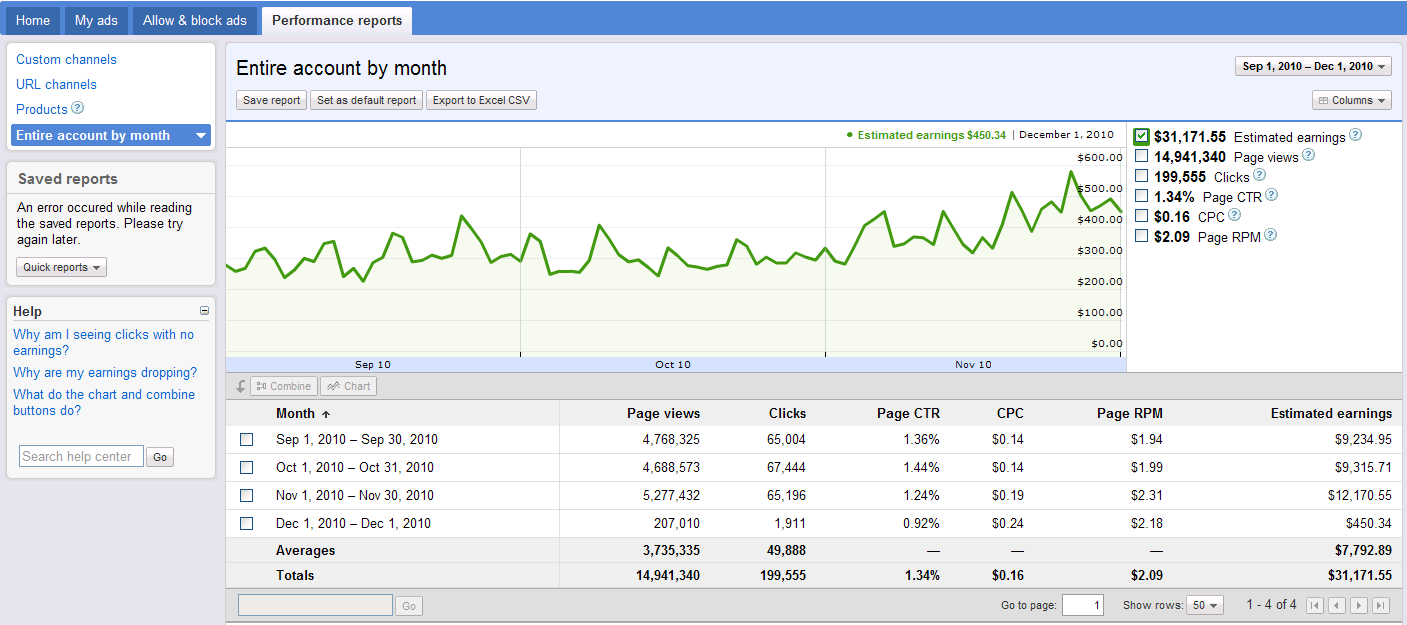
In the next few posts in this series, we’ll focus on different types of reports you can quickly view in the new interface to monitor and gain insight into your ad performance. Today we’re highlighting the ability to quickly view performance by month. We’ve chosen this particular feature because it’s been a top request from publishers, but you can easily do the same by day or week.

Previously, the easiest way to view all account data by month was to export all reports to CSV, then post-process the data in a spreadsheet. Now you can get the same data with just two clicks without leaving your account. On the Performance reports tab, first click on 'More reports,' and then 'Entire account by month.' From here you can see a graph of your earnings. Immediately below the graph, you’ll see data for your account by month. As we mentioned last week, you can easily select the metrics to appear on the graph.


Give it a try today! Navigate to the new interface and click on the Performance reports tab, 'More reports,' and then 'Entire account by month.'

Wednesday, 26 January 2011

New Interface Wednesdays: Graphs right in your account

This is the first post in our ‘New Interface Wednesdays’ series. Every Wednesday for the next few months we'll highlight something new you can do in the new AdSense interface. From time to time, we’ll also share stories directly from publishers who've been using the new interface and announce additional features we’ve recently added.

For our first ‘New Interface Wednesdays’ post, we’d like to highlight the graphical reporting under the Performance Reports tab in the new interface. The new graphs make it easy to see trends in your performance. Rather than scanning rows of numbers, you can view impressions, clicks, and earnings, all in one graph.

Select the metrics you want to see by checking the boxes next to the graph. You can also hover over the graph to get detailed metrics for a specific day, just like in Google Analytics. The graph will appear for just about any type of report you run, making it easy for you to visualize performance. Above the graph, you'll find buttons to save reports that you commonly use and set a report of your choosing to be the default report with a single click. Of course, you can still export the data to a CSV to further process the data in a spreadsheet as well.


If you aren’t yet familiar with the graphs in the new interface, check them out today. Navigate to the new interface and click on the Performance reports tab.

Thursday, 30 September 2010

Insight into your earnings (Part II): How smart pricing fits in

Last week, in the first half of our series designed to help you better understand your earnings, we introduced you to the ad auction for AdSense for content. To recap, eligible ads compete to appear on your pages; our ad auction determines which ads show, and how much you can potentially earn from them.

Now, let’s talk about smart pricing, a tool designed to help advertisers bid efficiently and effectively on many publishers’ ad auctions at once. Our Chief Economist, Hal Varian, explains the purpose of smart pricing, how it plays a role in the ad auction, and how it benefits the entire advertising ecosystem of publishers, advertisers, and users.

Although we aren’t able to provide detailed explanations of our algorithms, we’d like to address a common misconception and show that smart pricing isn’t intended to be a ‘punishment’ for publishers. It’s designed to increase advertiser confidence in AdSense sites by helping them set more accurate bids that reflect the business results they’re looking for. This then allows advertisers to increase their maximum bids, which ultimately helps publishers earn more in the long run.

We’ll let Hal explain the concept of smart pricing in more detail:


Finally, we’d like to take a moment to address some of the questions we’ve received about the relationship between smart pricing and the AdSense for content revenue share. Smart pricing can impact which ad wins an auction for a particular content page. However, since the revenue share is fixed for all publishers, smart pricing doesn’t impact the percentage you actually earn for a valid click. Any changes to advertiser bids as a result of smart pricing will proportionately affect the amount both Google and the publisher earn.

Thanks for following our two-part earnings series. We hope you found the content useful, and that you now have a better understanding of the factors that influence your earnings.

Thursday, 23 September 2010

Insight into your earnings Part I: Explaining the ad auction

"Why do I earn more money from some ads and less from others? Why do my AdSense for content earnings vary from day to day, or week to week?"

If you’ve asked yourself questions like these before, you’re not alone -- we often hear from publishers that they’re unsure of how earnings are calculated and why their earnings fluctuate. As part of our efforts to be more transparent with publishers, we’re kicking off a two-part series to help explain these topics. With the help of Hal Varian, the Chief Economist here at Google, we’ll show you how ads are targeted to your pages, priced by the ad auction, and translated into the earnings you receive.

Today, Hal will introduce you to the ad auction for AdSense for content ads, and explain both what it’s for and how it works. Like a traditional auction, advertisers bid in our ad auction to show ads on your pages. The number and price of ads in the auction changes from moment to moment, based on how much advertisers are willing to spend and how they've set up their ad campaigns -- this is why we call our auction ‘dynamic,’ as these factors can then affect how much you earn.

If you’re ready to learn more about the ad auction and how specific prices are calculated, watch the video below and visit our Help Center.


So what can you do as a publisher to ensure you’re maximizing your earnings? Here are some tried-and-true tips to increase the amount of competition among advertisers in the ad auction for your pages.
  • Keep creating high-quality sites full of original content to attract more advertisers, and use Google Analytics to see which content is generating revenue.
  • Try adding popular advertiser formats such as the 300x250 medium rectangle to your pages.
  • Turn your channels into targetable ad placements to help advertisers identify and target premium locations on your pages.
  • Experiment to find the optimal locations for your ads, while making sure that your layouts won't generate accidental clicks.
  • Help advertisers find your sites by claiming them in Ad Planner. You can add descriptions and categories that describe your content, which will help increase the visibility of your ad units to interested advertisers.
To understand changes in your earnings, we also recommend reviewing our two-part blog series, 'Diagnosing Revenue Fluctuations.'

That’s it for today. In Part II of our series, we’ll discuss how smart pricing affects advertiser bids in the ad auction, and clear up some myths about how it works.

Thursday, 27 August 2009

Euro reporting for more European countries

If you're a publisher located in Cyprus, Luxembourg, Malta, Monaco, San Marino, Slovenia, or Vatican City, you can now switch to local currency reports to view your earnings in Euros. Once you make this change, any earnings generated from advertisers paying on other currencies will be converted to Euros each day. This also means that if you're receiving payments in Euros, there won't be any additional conversions at the end of the month when payments are issued.

Before you switch to local currency reports, we suggest you download and save copies of your past reports in U.S. dollars for your records. Once you've done that, look for the green prompt in the upper right hand corner of your Reports Overview page. Click the link in the prompt, and you'll be asked to agree to a new set of Terms and Conditions. If you have questions or need legal advice on interpreting the new Terms, please don't hesitate to contact your attorney.

We encourage you to switch to local currency reports soon, since we'll be requiring this update in the future. You can learn more about these new reports in our Help Center, and we also recommend reviewing answers to a few FAQs we covered on the blog before.

Tuesday, 21 July 2009

Expanding availability of local currency reports

We've been working to enable local currency reporting in more countries, and are happy to announce that this feature is now available for publishers located in Denmark and Norway. As a reminder, switching to these new reports means that all earnings generated from advertisers paying in other currencies will be converted to your local currency each day. If you receive payments in your local currency, there won't be any additional conversions at the end of the month, but you can still update your payment method and currency at any time.

If you're located in one of these countries, we recommend that you first download and save copies of your past reports in U.S. dollars for your records. Once you're ready to switch to local currency reports, sign in to your account and look for the green prompt in the upper right hand corner of your Reports Overview page. Click on the link, and you'll then be asked to agree to a new set of Terms and Conditions. If you have questions or need legal advice on interpreting the new Terms, please don't hesitate to contact your attorney.

We encourage you to switch to local currency reports soon, as we'll be requiring this change in the future. To learn more about these new reports, visit our Help Center or review common FAQs in a recent Inside AdSense blog post -- all references to 'Euros' in the post now also apply to your local currency.

Updated for accuracy

Monday, 15 June 2009

Local currency reports for nine more countries

Following our launch of Euro reporting for publishers in five European countries, we're happy to announce that local currency reports are now also available in Australia, Austria, Belgium, Finland, Greece, Portugal, South Africa, Switzerland, and the UK.

If you're located in one of these countries, you can now update your account to display earnings in your local currency. After you've updated your account, any earnings generated from advertisers paying in currencies other than your local currency will be converted daily. If you receive payments in your local currency, this means that there also won't be any additional conversions at the end of the month. However, you can still choose to receive payments in U.S. Dollars or change your payment method at any time.

Before enabling local currency reports in your account, we recommend downloading and saving copies of your past reports in U.S. Dollars for your records. You can then update your account by signing in to AdSense and clicking the link in the green prompt on your Reports Overview page. You'll be asked to review and agree to a new set of Terms and Conditions. Unfortunately, we're not able to interpret the meaning of changes in our legal documents for publishers -- if you have questions or need legal advice on interpreting the new Terms, please don't hesitate to contact your attorney.

We'll be requiring this change in the future, so we recommend updating your account to report earnings in your local currency soon. You can find answers to common FAQs associated with these new local currency reports in a recent Inside AdSense blog post -- all references to 'Euros' in the post now also apply to your local currency. In addition, detailed information about these new reports can be found in our Help Center.

Friday, 5 June 2009

Top ten myths about Google Analytics

A few weeks back, we announced that all publishers can now integrate their AdSense accounts with Google Analytics. If you're not very familiar with Analytics yet, you might be interested in reading a recent post on the Analytics blog that addresses ten common myths about the product. For example, did you know that you can use Analytics to segment visitor data in real time, or that you can use the new Analytics API to tie your website data to your financials? Check out the post to learn more about these features and other ways you can use Analytics to better understand your site stats.

If you haven't yet linked your AdSense account with Analytics, follow these steps:
  1. Sign in to AdSense.
  2. Click the link that says "Integrate your AdSense account with Google Analytics" on your Reports Overview page.
  3. Follow the onscreen instructions, and watch our video for additional guidance.
Even if you use AdSense in a language that's not supported by Analytics, you can still link your accounts and view your Analytics reports in a different language.

Thursday, 21 May 2009

Euro reporting and you: your questions answered

Since introducing reports in Euros for publishers located in France, Germany, Italy, the Netherlands, and Spain, we've received a number of questions about this launch. For publishers in these regions, we've addressed some of your concerns below.

How will my earnings be converted to Euros?
Once you switch to the new reports, earnings generated from advertisers paying in currencies other than the Euro will be converted. This will happen on a daily basis using the prevailing market rate from the previous day. If you generate earnings from an advertiser paying in Euros, they won't be converted.

When I'm issued a payment, will my earnings be converted again?
If you've switched to Euro reports and are receiving payments in Euros, there will be no additional conversions when your payments are issued. However, if you're receiving payments in U.S. Dollars, your payment will be converted from Euros to U.S. Dollars at the end of the month.

When I switch to Euro reports, will that automatically change the currency of my payments?
No, your selected payment currency and method won't change after you switch to Euro reports -- unless, of course, you want them to change. (You can update them by visiting the 'Payments Details' section under your My Account tab.)

Will there be a delay in receiving my unpaid earnings once I make this change?
No, making this change will not affect the timing of your payments. After you switch to Euro reports, your unpaid earnings in U.S. Dollars will be converted to Euros before the next upcoming payment selection deadline (typically the 15th of each month). For instance, if you make this switch on June 3rd, your unpaid earnings will be converted by June 15th; if you make this switch on June 20th, your unpaid earnings will be converted by July 15th.

How will this change influence VAT and any taxes I have to pay?
While you may receive your payments in your local currency, all payments are being made by Google Ireland, a company incorporated under the laws of Ireland, in accordance with the terms of your agreement with Google. Unless your business is in Ireland, you shouldn't have an obligation to charge Google VAT or treat any of our payments to you as VAT that needs to be paid to any VAT authorities. If your billing address is located in Ireland, you may have an obligation to charge Google Irish VAT. For more specific answers, we suggest you head for your local tax adviser.

I'm not located in France, Germany, Italy, the Netherlands, or Spain. When will you include other countries?
We're working to offer Euro reports to publishers located in additional countries. When we do, we'll be sure to post any updates here on Inside AdSense.

Do I need to update my account if I'm eligible?
Although this change is currently optional, in the future we will require that publishers located in eligible countries make this switch. Eligible publishers who haven't yet updated their accounts will currently see an interstitial page with additional information after signing in. We understand that some eligible publishers would like to continue receiving payments in U.S. Dollars; while you can still choose to be paid in U.S. Dollars, it will be mandatory to view your reports in Euros.

If you're eligible to make the switch to Euro reporting, we encourage you to review the updated Terms and Conditions and update your account soon. To get started, sign in to your account and look for the prompt, "See your daily earnings reported in Euro amounts!" on your Reports Overview page. You can also find more information in our Help Center.

Wednesday, 29 April 2009

Analytics integration for all

Over the past few months, we've been gradually inviting publishers to integrate their AdSense accounts with Google Analytics, and today we're happy to announce that this feature is now available to all publishers. Integrating your account with Analytics will provide you with more detailed information about traffic to your pages and how users interact with your site.

Once you link your accounts, you'll find an AdSense-specific menu under the 'Content' section of the left-hand navigation bar on your Analytics homepage, containing these reports:
  • The Top AdSense Content report allows you to see more details about specific pages on your site and analyze ad performance. For instance, if you find that some of your pages generate a high number of pageviews but aren't monetizing as well as other pages, you can focus your optimization efforts on improving these pages.
  • The Top AdSense Referrers report can help you see how different incoming traffic sources contribute to your revenue.
  • Last, the AdSense Trending report lets you analyze how your site generates revenue during different times of the day and different days of the week.


You'll also notice that other sections of your Analytics account will show a new 'AdSense Revenue' tab. You'll be able to compare how much of your AdSense revenue is coming from new visitors versus existing ones, and view revenue based on user language.

To take advantage of these new reports, sign in to AdSense and click the 'Integrate your AdSense account with Google Analytics' link on your Reports Overview page. You'll be taken to a step-by-step wizard that will guide you through the rest of the process. If you use AdSense in a language that's not supported by Analytics, you can still link your accounts and view your Analytics reports in a different language.

We also recommend watching the video below, which will help explain the linking process:


Enjoy your new data, and don't forget to visit our Help Center if you have other questions about linking your accounts or reviewing your reports.

Tuesday, 3 March 2009

Reports have gone international

One of the requests we frequently hear from our international publishers is to view reports in currencies other than U.S. Dollars. That's why we're happy to announce that publishers located in France, Germany, Italy, the Netherlands, and Spain can now view AdSense reports in Euros.

If you're located in one of these five countries and make this update, we'll convert your earnings to Euros on a daily basis using the prevailing market rate from the previous day. With earnings converted daily, you'll avoid the risk of currency exchange fluctuations between USD and the Euro. You can still choose to receive payments in either Euros or U.S. Dollars and select from a range of payment methods as well.

To make the switch to local currency reports, you'll need to agree to a new set of Terms and Conditions. Here are the main changes involved:
  • The party that publishers are contracting with changes from Google Inc. to Google Ireland Limited.
  • Publishers are responsible for paying any local taxes in their jurisdiction. Google will only issue VAT refunds to publishers with an address in Ireland.
  • The governing law changes from California law to either English or local law.
You can view the full text of these new Terms and Conditions by logging in to your account and looking for the green prompt, "See your daily earnings reported in Euro amounts!" on your Reports Overview page. Unfortunately, we're not able to interpret the meaning of changes in our legal documents for publishers -- if you have questions or need legal advice on interpreting the new Terms, please don't hesitate to contact an attorney.


Before agreeing to the new Terms, we also recommend that you download and save copies of your past reports in U.S. Dollars for your records. Once you update your account, you'll be able to view current and historical reports only in Euros. However, you'll still be able to view your prior payment history of U.S. Dollar earnings.

We encourage you to update your account to local currency reports soon, as we may require this change in the future. If we're able to offer this to publishers in other countries, we'll provide details here on Inside AdSense. For more information, please feel free to visit our Help Center.

Sunday, 15 February 2009

Reports being updated

Yesterday, we experienced an issue which caused AdSense and Google Ad Manager reports to be delayed through the day. The issue began at 4am PST and lasted several hours, but has now been resolved. No stats from yesterday were lost, and our engineers have been working to restore your reports with the clicks, impressions, and earnings accrued from your sites. Most publisher reports have now been updated with yesterday's data, with a few accounts still catching up.

Thanks for your continued patience, and we apologize for the alarm and inconvenience caused by this reporting delay.

Thursday, 4 December 2008

Make your ad cents (and dollars) count

Back in May, we had tremendous interest from readers who asked if they could donate their earnings to help victims in China and Myanmar (Burma). We heard you loud and clear, and so we're happy to announce that during the next week, you can donate a portion or all of your entire unpaid balance as of November 30, 2008 to reconstruction efforts in these regions. The earth may no longer be quaking and the waters may now be calm, but help is still needed in these areas. Whether you have a balance of $0.10 or $100 in your account, we invite you to participate within the next week. Just think if everyone donated a dollar, what a difference that would make.

As you may expect, there are certain restrictions to donating, and all our normal policies still apply -- so please don't ask others to click on your ads in order to increase your earnings. For more information on how to participate, visit our donation form.

Finally, we know that you may be interested in donating your earnings to additional charities and causes. Please stay tuned to our blog for future opportunities to donate in other ways.

Wednesday, 22 October 2008

Make a date with data in Google Analytics

Here in AdSense, we’re big on data. From spreadsheets and graphs to weekly reports and metrics, we constantly turn to numbers when running our business. In a similar vein, we've heard your requests for more data to help you run your AdSense websites, which is why we’re excited to announce the integration of one of our personal favorite reporting tools, Google Analytics, with AdSense. We're gradually rolling out this functionality to publishers, and you'll see an invitation link at the top of your 'Overview' and 'Advanced Reports' pages when it's been enabled for your account.


By integrating your AdSense account with a new or existing Analytics account, you’ll have access to in-depth reports about user activity on your site. In addition to the wealth of metrics already available in Analytics such as unique visitors and visitor language, you'll now have access to granular reports that break down AdSense performance both by page and by referring site. Armed with this new data about user behavior, you’ll be able to make more informed decisions on how to improve the user experience on your site and optimize your AdSense units to increase your revenue potential.


We've highlighted a few ways to use the integrated metrics below, but we encourage you to be creative! Come up with your own to discover how useful (and fun) new data can be:
  • Discover untapped markets. Use the geographies report to determine which regions are under-represented in your site’s user base. Optimize your site’s content to attract more of these under-represented users.
  • Drive high-earning traffic to your site. Use the 'Referring sites' report to determine where the users who are making you the most money are coming from. Focus your efforts on getting traffic from these sources.
  • Delve deeper into AdSense reports. Use the visualization feature to look at trends in your site's AdSense performance over time, or by time of day.
Again, this feature is not yet available to all our publishers, but please keep checking your account for an invitation. In the meantime, you can take a look at our demo to learn more about the reports you'll have access to:


Tuesday, 14 October 2008

The case of the delayed data

Do you frequently log in to your account to check your stats? We've heard from some publishers that they check their accounts every hour, or even multiple times an hour, and we're definitely happy to see your enthusiasm for the program! (For all of our blog veterans reading this post, you might recognize these as the symptoms of G.A.S.S..)

On that note, many publishers have asked us why they don't see any changes in their stats each time they log in, or why they sometimes see a 'No data available' message in their reports. This is because your reports are generally updated every 15 to 30 minutes, but there can sometimes be a delay of up to 24 hours. In addition, it can take up to 24 hours to fully verify our internal logs and finalize your reports -- as a result, you may sometimes see changes in your earnings during the course of the day. Please also keep in mind that your reports won't show data for impressions on public service announcements (PSAs).

How often do you check your account? Let us know in our comments field below :)

Friday, 15 August 2008

Seeing clicks but no revenue?

Have you ever checked your reports and noticed that you have clicks reported, but no revenue? We'd like to explain why this may happen, as we frequently receive emails and questions on our Help Forum about this issue. What you're seeing may be due to one of the following:
  1. Allowed Sites setup

    The Allowed Sites feature allows you to specify a list of sites where ads from your account may be displayed. If you're using this feature, you'll need to make sure that you've listed all sites where you'd like to display your AdSense ad code.

    To check if this is the case, log into your account and visit the 'Allowed Sites' page under your AdSense Setup tab. If the radio button 'Allow any site to show ads for my account ' is populated, you're not being affected by this issue, and you should continue to #2 below. However, if 'Only allow certain sites to show ads for my account' is populated, review the list of sites in the box below -- are all the sites you own listed in this box? If the answer is 'no', you won't be credited for clicks on the missing sites. Please be sure to add all of the sites where you'd like to display your AdSense ad code.

    We've noticed some confusion among publishers who have entered the sites of advertisers they'd like to see on their pages into the Allowed Sites list. Please know that this is not the case, as it's not possible to request ads for a particular page - the sites you enter into this box can only be sites where your ads can be placed.

  2. Invalid clicks

    It's possible that you have some clicks that our monitoring system has considered to be invalid. As we've mentioned before, we monitor all clicks and impressions on Google ads for any activity that may artificially drive up an advertiser's costs or a publisher's earnings. Any clicks that our system considers invalid will still appear on your 'Overview' page, under the Reports tab. However, because our advertisers aren't charged for these clicks and impressions, we won't show the earnings for this activity. If you're concerned about suspicious activity in your account, we recommend reviewing your site's logs and letting us know about the situation.

    Rest assured that AdSense accounts are properly credited for all clicks and impressions we consider to be valid. We'll post your finalized earnings for a given month on your 'Payment History' page during the first week of the following month. For more information about invalid clicks, please review our Help Center.

Tuesday, 15 April 2008

The report of these link units is not exaggerated

I don't know about you, but I'm a big fan of data. I look at my own reports frequently and use channels to track the performance of individual pages and ad units so I can optimize my AdSense experience.

I'm also a fan of AdSense for content link units. As we've mentioned before, these units pack a big punch while conserving your screen real estate and can be a great addition to a page that's already using one of our many other products. We've also been doing a lot of work lately to improve the targeting of link units.

This is why I'm happy to announce that my two loves are now coming together. As of today, we've enhanced your reports so that you can view the performance of link units separately from your other AdSense for content units. Even better, the link unit-specific reports contain more information about your link units. A lot of publishers have been asking us for more statistics on their link units, such as the per-link CTR and the number of click-throughs to the link units results page.

To view your new, improved reports, visit the Advanced Reports page under your Reports tab and select AdSense for content. You'll notice a new option to customize your reports -- 'Choose Units'. A 'Combined' report will look just like the data you're used to seeing in your AdSense for content reports, while choosing 'Ad Units' or 'Link Units' will help you look at things with more granularity.


Please note that data is only available dating back to May 2007. Right now, we're having a little issue where, if you generate a report with a date range starting any earlier than May 2007, our report won't show any data, even if there is data after May 2007. Rest assured that our engineers are aware of the issue and are working to display all available data even if the date range starts before May 2007.

Remember, you're allowed to put up to three link units on any given page in addition to your three regular ad units. With better reporting and improved performance, now is the perfect time to start using link units if you aren't already.